Sunday, December 21, 2014

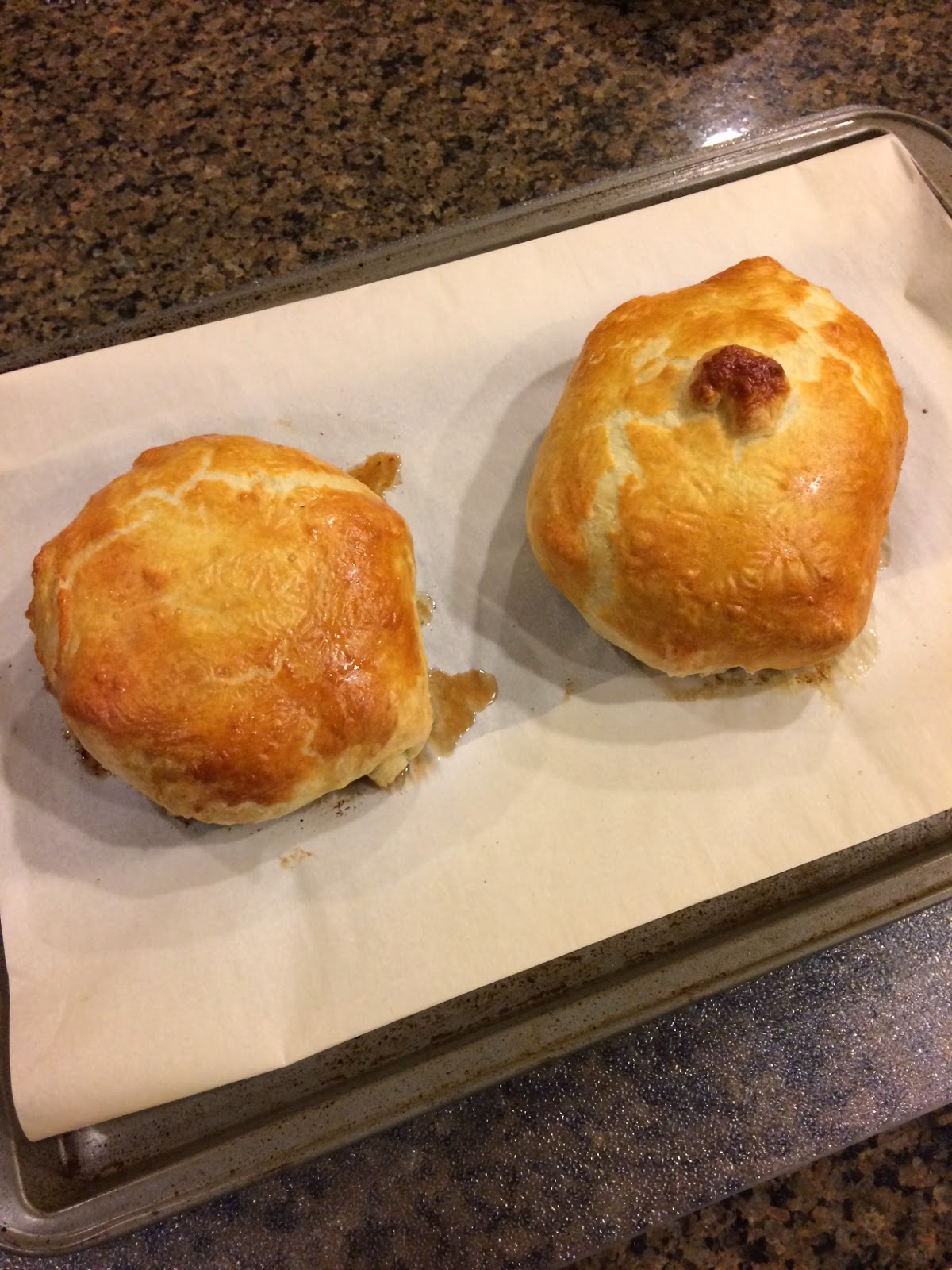
My Kids Made Beef Wellington!

Beef Wellington is one of those intimidating “wow factor” dishes consisting, with some variation, of a seared filet mignon smothered in a whole-grain mustard and duxelles (mushrooms that have been pulverized into a paste), and puff pastry. The whole package is then baked until the crust crisps up and the meat reaches medium-rare perfection. It looks damn impressive and holds delicious layers of flavor. 


Here, my daughter and son-in-law are taking on this ambitious project putting together individual Beef Wellingtons that they adapted from Gordon Ramsay's version, along with pan roasted tri-colored fingerling potatoes and haricots verts, to celebrate several recent events in their life - George's birthday, his earning a PhD and their first dinner in their new home. Important life passages like those require a special meal like this! 

Check out these photos - 


How it's done - 

INGREDIENTS

For mushroom duxelles:
1 tablespoon extra-virgin olive oil
1/2 teaspoon salt
1/4 teaspoon black pepper
1 pound cremini mushrooms, coarsely chopped

For herb crepe:
2 eggs
1 teaspoon sugar
1/2 teaspoon salt
2 tablespoons chives, minced
1/2 cup whole milk
1/4 cup water
4 tablespoons butter, melted, plus more if needed for pans
1/2 cup all-purpose flour

For Beef Wellington:
2 pounds filet mignon
Salt and black pepper, to taste 
2 tablespoons olive oil 
1/4 cup whole-grain Dijon mustard 
1/2 pound prosciutto di Parma 
1 sheet puff pastry, thawed 
1 egg yolk 
1 tablespoon whole milk

DIRECTIONS

To make mushroom duxelles:  

Add mushrooms to a food processor and process until completely smooth. The consistency is similar to wet hummus.

In a pan over medium heat, add mushroom paste, olive oil, salt, and pepper. Spread the mixture evenly over the surface and cook on a medium-low heat until the moisture in the paste has reduced and the mixture has the consistency of a spreadable pâté. Remove from heat and let cool.

To make herb crepes: 
In a large bowl, whisk together flour, eggs, sugar, salt, and chives. Whisk in milk, water, and 1 tablespoon of melted butter, until smooth and emulsified.

Heat a crepe pan or large skillet over medium heat. Add remaining 3 tablespoons of butter. 

Add 1/4 cup of the batter. Rotate pan in a circular motion over the heat to completely cover the surface with the batter. The edges of the crepe will begin to curl slightly as the crepe cooks. Cook for approximately 45 to 60 seconds, then flip crepe to cook the other side. Each side should be a pale golden brown. Remove from heat. Add more butter if needed to the pan and repeat process with the remaining batter. Set crepes aside.

Preheat the oven to 400º F.

To make steaks: 
Pat filet mignon dry with paper towels and season generously with salt and black pepper. 

Heat a skillet over medium-high heat and add olive oil. When the oil begins to smoke, add the filet mignon and brown from 1 to 2 minutes on all sides. You want to create a nice sear on the outside of the steak but leave the inside raw. Remove from heat and place on a cutting board to cool.

Cover cooled filet with Dijon mustard.

To roll the beef Wellingtons: 
On a cutting board, lay out a long piece of plastic wrap. In the middle of the wrap, lay out a crepe. Spread mushroom duxelles over the crepe. Lay out the prosciutto on top of the duxelles. Place filet in the center of the crepe and gently wrap the crepe around the filet. Trim off any excess and use the plastic wrap to tightly wrap the steak.

Lay out a clean, long piece of plastic wrap. Gently roll out puff pastry until it is a 1/4-inch thin. Place the wrapped steak on one end of the puff pastry and wrap. Pinch the ends closed and trim off any excess puff pastry. Use the plastic wrap to tightly seal the puff pastry. Pop it in the fridge for about 5 minutes to let it firm up again.

In a bowl, mix together egg yolk and milk.

Place a sheet of parchment paper or aluminum foil on a baking sheet. 

Remove Wellington from fridge, remove the plastic wrap, and lay the Wellington seam-side down on the baking sheet. Baste the top of the puff pastry with the egg wash and bake for approximately 25 to 30 minutes or until the internal temperature of the steak reaches 125º F, or to whatever temperature you prefer your steak.

Remove from the oven and let rest for at least 10 minutes before slicing into medallions. 

Serve warm.

Sunday, December 14, 2014

Horseradish Sauce

Well, it was supposed to be artichoke root stock...
When it started coming up out of the ground, it looked like this -
As it grew, it developed leaves like this - 
This is not what artichoke plants look like. These leaves are huge. Is it tobacco? I did some research and found out what we had was horseradish. Not what we wanted but we let it grow. The leaves are edible, so we cut some and sauteed them up. They taste just like you'd expect horseradish leaves would taste - like horseradish. The leaves are mild, it is the root that has the real pungent sinus opening punch. Grated Horseradish root is what is used in horseradish sauce for prime rib, to make cocktail sauce and Chinese mustard. The root is typically harvested after the cold weather in the fall kills back the above ground leaves.

Here are some of the roots I dug up  on December 14.


We thought about making Chinese mustard but since we had a couple strip steaks, we figured a creamy horseradish sauce would go great with them. You can find horseradish root in most supermarkets. It will be larger than what we harvested from our garden, more like the size of a small turkey leg. You would need to peel and grate it.

Ingredients:

1 cup sour cream
1/2 cup grated for minced fresh horseradish root
1 tablespoon Dijon mustard
1 teaspoon white wine vinegar
1/2 teaspoon kosher salt
1/4 teaspoon freshly ground black pepper

Directions:

After cleaning the roots, cut them into pieces and chop to a fine texture in a small food processor, then add the rest of the ingredients and blend until the mixture is smooth and creamy. Place in the refrigerator for at least 4 hours or overnight to allow flavors to meld. The sauce can be stored in the refrigerator in an airtight container for 2 to 3 weeks.

Lisa's OCD sometimes comes in handy as evidenced here in how she put all the ingredients together!  : )


The sauce was very good, perfect with the grilled strips.


Friday, December 12, 2014

Rustic Whole Wheat Oatmeal Bread or Oatmeal Whole Wheat Bread

Some breads are meant to be part of a cold meat sandwich, some to be grilled for bruschetta, some are meant to be enjoyed with sharp aged cheese and some for a simple peanut butter sandwich. This rustic bread - so simple and easy to make and so good - is one of those breads that is meant to be served warm and slathered with butter, real butter, not margarine that supposedly tastes like butter. Fresh homemade bread slathered with butter is one of those simple pleasures in life you have to let your family experience. 
Ingredients

2 cups whole wheat flour
1 1/4 cups unbleached all purpose flour
1/2 tsp salt
1 packet instant yeast
1 1/2 cups warm water
1/2 cup rolled oats

Process


Combine warm water with yeast in a large mixing bowl and let set for 5 minutes.

Add the whole wheat and all purpose flours and salt stir together. The dough will be a sticky, rough dough.

Lightly grease another bowl, wet your hands and lift the dough out and into the second bowl.

Cover with plastic wrap and let rise in a warm place for an hour. It will double in size.

Sprinkle the dough with flour and transfer to a generously floured work surface. 

Knead a few times adding flour as needed to make it easier to handle – a dough scraper will help – then add the oats a little at a time and knead until they are incorporated and the dough is no longer sticky.

Place on lightly greased baking sheet and sprinkle a light coating of flour over the top. Let rest for 45-60 minutes.

Preheat oven to 450°F and place a metal or cast iron pan on the lowest oven rack, and have 1 cup of hot water ready.

When ready to bake, make 2 -3 slashes in the top of the dough, making a cut about ½-inch deep.

Place bread in the oven and carefully pour half a cup of hot water into the shallow pan on the rack beneath. Close oven door quickly. The steam produced will help the dough expand in volume quickly when it hits the heat in the oven. This is called ovenspring. It will also help form a better crust.

Bake the bread for 25 to 35 minutes, or until golden brown and crusty.

Remove the bread from the oven and cool on a rack.

Once cooled, but still warm, cut a few pieces for you and your loved ones and slather with butter – REAL BUTTER, damn it – and ENJOY!

Note: In case you are wondering, this cool cutting board, in the shape of the State of Pennsylvania, was a gift from my son Michael and daughter-in-law Miranda.

Thursday, December 11, 2014

Osso Buco


This is one of those special wow factor dishes for special occasions. I’ve made it many years for Christmas Day dinner. The prep is the only time consuming part, the rest is pretty easy.

Osso buco is traditionally served with Risotto alla Milanese but you could also serve it with mashed potatoes or, my choice, over cheesy parmesan polenta.

You won’t usually find veal shanks in a supermarket. You may have to special order them but better to go to a good butcher shop. Ask the butcher to cut the shanks into 2 ½ inch thick slices from the middle part of the shank; the ends of the shank are mostly bone and do not have as much meat. If you don't want to use veal, substitute with pork shank and have it cut the same way - from the middle and 2 1/2 inched thick.  
The bone marrow is important in the preparation of Osso Buco because during the cooking process it melts down, producing the signature flavor of the dish.

It’s a good idea to tie each piece of veal with a piece of kitchen string around its girth to keep the shank from falling apart during cooking. The veal should braise until the meat could fall off the bone and can be eaten with a fork.

For the veal - serves 2
2 Veal shanks cut  2 ½  inches thick
Flour for dredging
Salt & Pepper
2 tablespoons butter
2 tablespoons olive oil
1 medium onion minced
½ cup celery minced
½ cup carrot minced
2 cloves of garlic minced
1 cup dry white wine (Pinot Grigio is good here)
1 ½ cup chicken stock
1 ½ cup crushed tomatoes in puree
2 sprigs worth of fresh rosemary
4 sprigs worth of fresh thyme

For the gremolata -
Make this at some point near the end of the cooking time and set aside
2 tablespoons lemon zest
¼ cup fresh flat leaf parsley minced
1 clove garlic minced

For the polenta -
4 cups water
1 teaspoon salt, plus extra for seasoning
2 cups yellow cornmeal or polenta
3/4 cup freshly grated Parmesan
1 cup whole milk, at room temperature
5 tablespoons unsalted butter, at room temperature, cut into 1/2-inch pieces
1/4 cup chopped fresh flat-leaf parsley
Freshly ground black pepper
Bring the water to a boil in a large, heavy pot. Add the salt. Gradually whisk in the cornmeal. Reduce the heat to low and cook, stirring often, until the mixture thickens and the cornmeal is tender, 15 to 20 minutes. Remove the pot from the heat. Add the cheese, milk, butter, and parsley. Stir until the butter and cheese have melted. Season with salt and pepper, to taste.

Directions - 
Heat oven to 350.

On medium heat, melt half the butter and half the olive oil in a Dutch oven.

Season the veal with salt and pepper then dredge in flour shaking off the excess.

Brown the veal in the Dutch oven. Then remove to a platter

Add the remaining butter and oil and saute the onion, celery, carrot and garlic for about 5 minutes.

Add the wine and deglaze scraping up any browned bits reduce for 2-3 minutes

Add the chicken stock, tomatoes, rosemary and thyme. Taste for salt and pepper.

Return the veal to the casserole. Make sure the sauce comes up to the top of the shanks add more wine or stock if needed.

Cover the pot and roast in oven for about 2 hours basting occasionally and adding water if necessary until meat is fork tender.

Towards the end of the cooking time make the polenta (or the mashed potatoes or the risotto Milanese). 

Remove veal from the casserole, turn off the oven and put the veal on a plate tented with foil back in the oven to keep warm.

With a immersion blender whiz the sauce in the casserole until smooth. Bring back to a simmer.

Spoon the polenta on to each plate and set a piece of osso buco on top

Ladle some of the sauce over the meat and sprinkle with the gremolata.

Serve with some crusty bread to mop up the sauce.

You probably won't have any left-overs but if you do, enjoy later. And if there is no meat but just sauce, it is wonderful over rice or noodles.

Wednesday, December 10, 2014

Pork Chops & Apples with Roasted Root Vegetables

Pork and apples is a food match made in heaven, just like fish and lemon, beef and mushrooms or well, peanut butter and jelly. They were all meant to be together! Pork's mild but savory flavor works well with anything that can give it a little jolt and one of the best pairing is with apples. Apples have both a sweet and a tart element, especially Granny Smiths, that really enhances a pork dish. 

Here we've pan seared a couple nice thick pork chops seasoned with ground fennel seeds - another good match with pork. Then added sliced Granny Smith apples, put the lid on, and finished cooking them together.


Roasted root vegetables for a side - carrots, parsnips and red onions.
Here it is plated up with pan drippings as a simple gravey

La Pignata - "Old School" Italian Cooking

"Good cooking is contemplative, it’s subtle. It’s timeless. It’s humbling to think of humanity, hunched over a fire, the clay pot one of our very few constants in a long and winding history."  -  Silvestro Silvestori
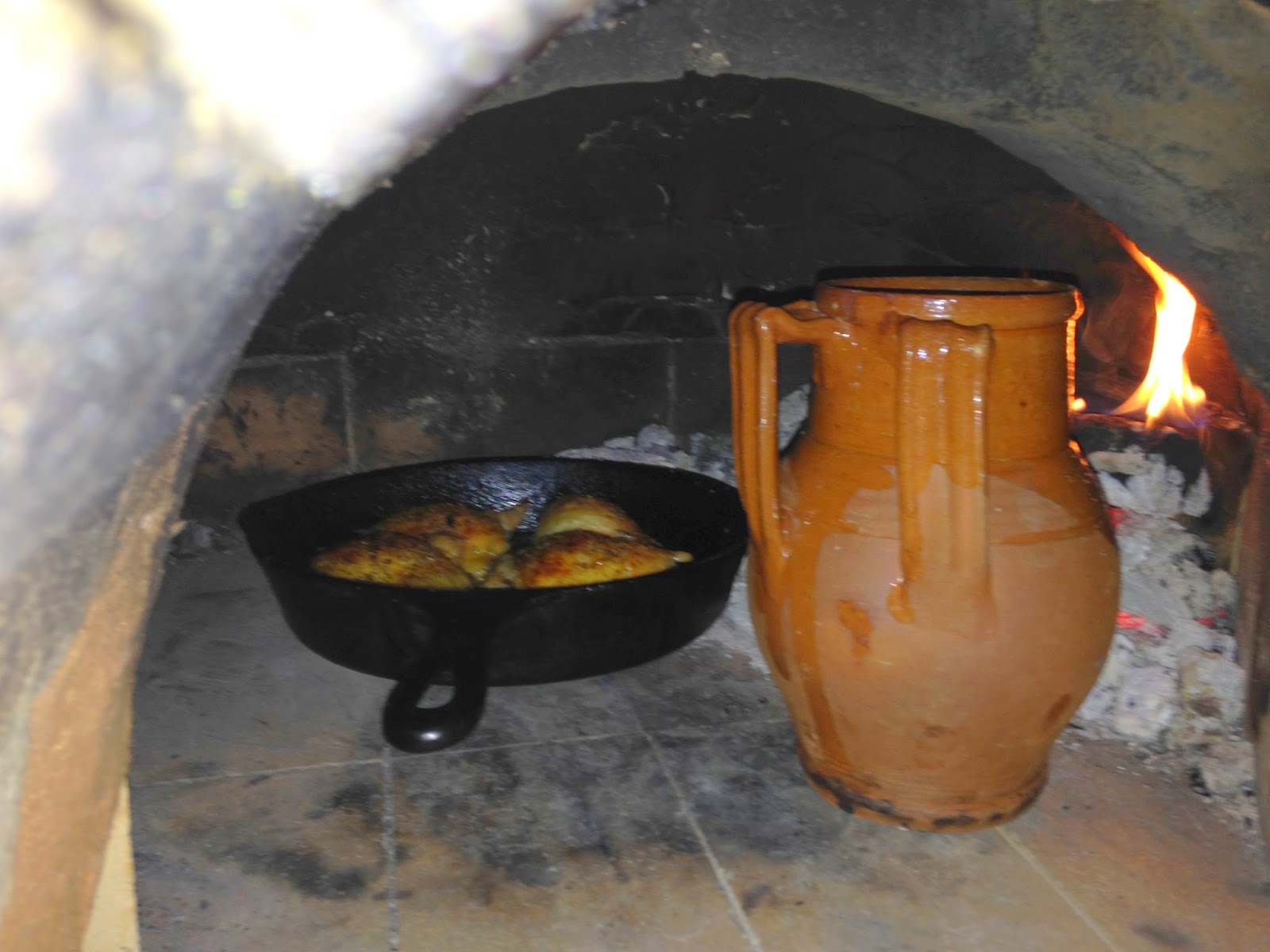
Cooking with a pignata in our clay oven
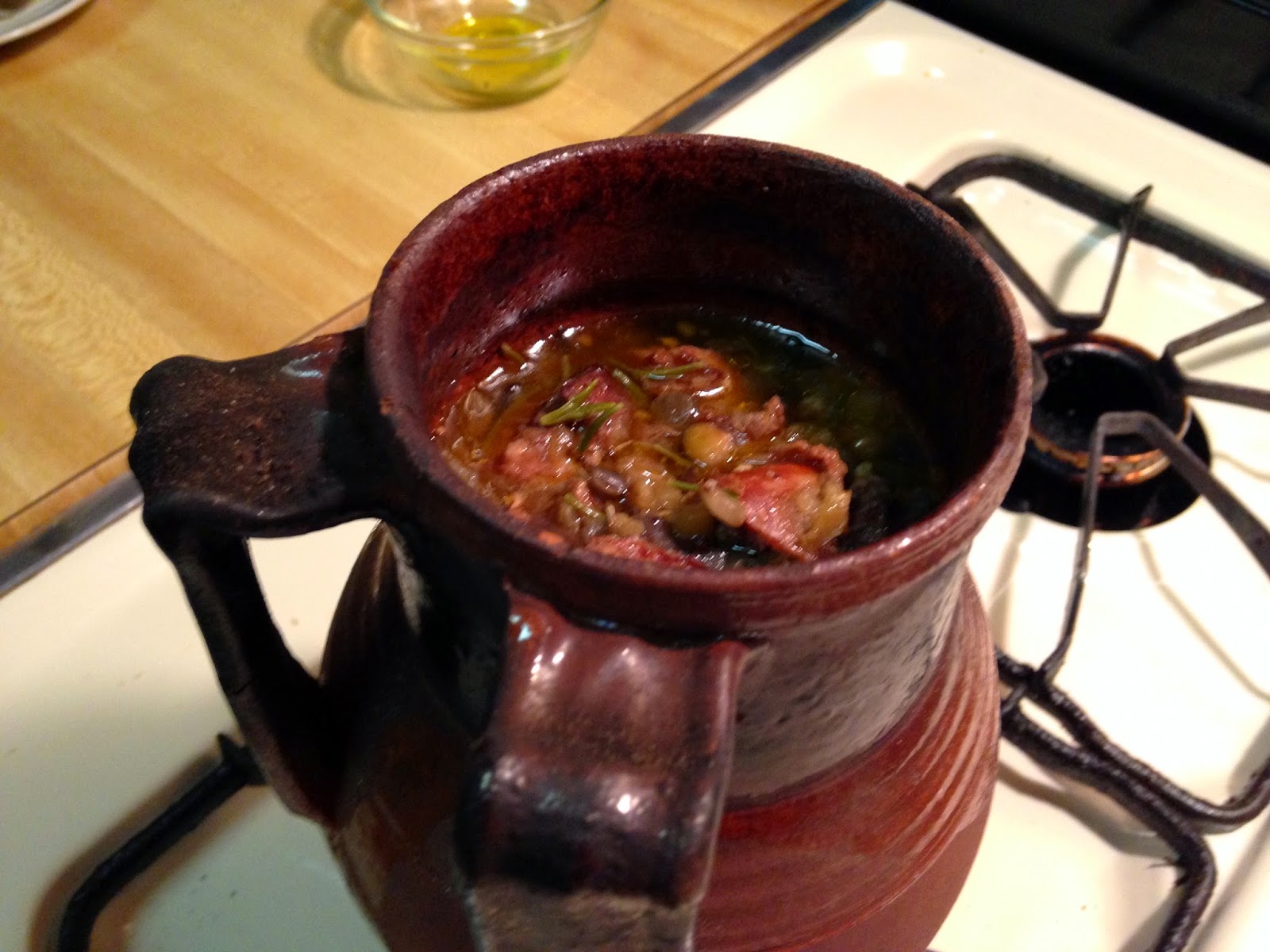
A pignata (pron: pin-YAH-ta) is a southern Italian clay cooking pot with a unique design that renders everything you put into it completely delicious. Nestled in embers fireside, they are used to slow cook everything from beans to stews to ragus and soups - part of la cucina antica - the ancient way of cooking. The pignata is the ancestor of today's crock pot with a design and utility that hasn't changed since the days of the Roman Empire. Pignate (pl) are fairly common in Italy but difficult to find here. My good friend Soni spotted one on ebay and let me know. Thanks again Soni!

Here are some basic recipes for cooking in a pignata. I will be adding more recipes 
regularly.

- Cannellini Beans with Pancetta

Ingredients:

2 cups dry Cannellini beans (or 2 cans of canned )
1/4 lb pancetta roughly chopped
1/2  medium yellow onion chopped
1 bay leaf torn in three pieces
1/2 teaspoon black peppercorns
1 teaspoon fresh rosemary
1/2 teaspoon fennel seeds
Extra Virgin Olive Oil
Salt
Water

If using dry beans, they need to be pre-soaked before using. 
Technique: 
- Sort through the beans and eliminate shriveled beans and any debris.
- Soak for 12 hours or over night covering the beans with about 2 inches of water. 
- Drain and put into a cooking pot again covered with about 2 inches of water.
- Bring the water to a boil. Boil for 5 minutes then remove from heat and let sit for an hour.
- Now they’re ready to put in the pignata.

I decided to fry the pancetta to render some of the fat and crisp it up a little. Then saute the onion in the fat. Cut the pancetta into several pieces.

Put all the ingredients except the salt into the pignata and add water to the top of the beans. Salt should be added when the beans are done.


Place the pignata with the beans in the oven near the embers. We cooked them along with pan roasted chicken thighs in our clay oven. About an hour and a half. The beans can cook even longer. The longer they cook the better they get.
Brought in the beans and chicken in to plate up. Dress the beans with a drizzle of good extra virgin olive oil.

- Lentils with Italian sausage

Ingredients:
1 cup of dry lentils
1/2 cup sweet onion chopped
3 cloves of garlic minced
2 Hot Italian sausage links
2 sprigs fresh rosemary

Soak the lentils in water for an hour
Pan cook or grill the sausages and cut into 1/2 inch slices
Add the lentils, onion, garlic, sausage slices and rosemary to the pignata in several layers.
Fill the pignata with water and place a lid on top.
When the oven has been fired and the the fire dies down to small licks and hot embers place the pignata in to the side opposite the fire.
Leave to cook for 3 hours checking every hour to see if more water needs to be added. Make sure any water you add is very hot.

We also made roasted root vegetables to serve with the lentils. They roasted for about an hour in a cast iron skillet close to the fire.


___________________________________________________________________

Pignate being used in Italy - 


Pieces of pork stewed in red wine, slowly cooked in a pignata with onion, celery, carrots, cherry tomatoes, new potatoes, thick slices of bacon, rosemary, oregano, bay leaves, cloves, sage, thyme, tomato sauce, salt, pepper and extra virgin olive oil.

- Lamb Stew
Source:  http://blog.giallozafferano.it/suditaliaincucina/agnello-pignata/

Carrots, potatoes, a stick of celery with a few leaves, a sprig of parsley, an onion, a clove of garlic, one or two sprigs of wild fennel, mushrooms  baby artichokes, 1 lb of lamb cut in one inch pieces, five or six sun dried tomatoes, bacon,  spicy sausage, and pecorino cheese rinds and pieces of caciocavallo cheese.
Load all the ingredients into the pignata and add enough water just to get to two fingers from the top. Cover with a tight fitting lid, placing dough around the edge to seal the gap between the lid and pot. If you don’t have a lid, make a lid from dough made from just flour and water.Roast for several hours. 


Bring the pignata to the table and open it in the presence of your guests, so they can enjoy the explosion of aromas when the crust is broken. Whoah!

More pics from Italy - 


Thursday, November 13, 2014

Salted Oatmeal Cookies With Dark Chocolate


This is my daughter Brittany's recipe. I'm still angry with her for serving them because they are so damn good. You really have to control yourself from eating too many. They're thick and chewy and the unexpected little hits of sea salt make the taste of the dark chocolate really pop. You want another just for that surprise. Make sure you use the Ghirardelli 60% cacao chocolate chips!

I am not a cookie baker and as much as I enjoy the challenge of making all kinds of other eats, I've never made a batch of cookies before in my life. But because I liked these so much, I had to make some myself.  These are good kept in the freezer too, by the way. They have a nice snap when frozen.

Ingredients

2  cups old-fashioned rolled oats (not quick-cooking) 
1 cup all-purpose flour, spooned and leveled 
3/4 teaspoon baking soda 
2  teaspoons flaky sea salt, divided
1/2 cup (1 stick) softened unsalted butter 
4 tablespoons coconut oil 
1/2 cup granulated sugar 
1/2 cup packed light brown sugar 
1 large egg 
1 teaspoon pure vanilla extract 
6 ounces Ghiardelli 60% cacao dark chocolate chips

Directions

Heat oven to 375° F with the rack in the upper and lower thirds.
Line 2 large baking sheets with parchment.

Combine the oats, flour, baking soda and 1 teaspoon of the salt in a medium bowl; set aside.

Beat the butter, coconut oil, granulated sugar, and brown sugar with an electric mixer on medium-high speed until lightly and fluffy, 2 to 3 minutes. Beat in the egg and vanilla.

Reduce the mixer speed to low and gradually add the flour mixture, mixing just until combined (do not overmix). Stir in the chocolate.

Drop heaping tablespoonfuls of the dough onto the prepared baking sheets, spacing them 2 inches apart. Sprinkle with the remaining 1 teaspoon of sea salt.

Bake, rotating the pans halfway through, until lightly brown around the edges, about 10 to 12 minutes. Cool slightly on the baking sheets, then transfer to a wire rack to cool completely.

Saturday, November 1, 2014

White Chili with Pork and Chorizo

Over the years I've come to like white chili better than red. Here is my take on white chili. So simple but so good, made in a crock pot. Don't be heavy-handed with the spices. They all play well together and you get a more rounded depth of flavor if they are understated. The chorizo really makes this - use just about 1/4 lb but the flavor infuses through the chili. We are lucky to have a good Mexican market near by that makes their own.


Ingredients:

1 1/2 lbs boneless pork spare ribs roughly cut into 1 inch chunks
1/4 lb fresh soft chorizo sausage (not hard), casing removed
1/2 large or one medium sweet onion chopped
2 cans cannellini beans
1 large or 2 small poblano peppers, chopped
1 dried hot chili pepper - leave whole
1 teaspoon fennel seeds
1 teaspoon oregano
1 teaspoon cumin
1/2 teaspoon chili powder
Salt & pepper to taste
Lime juice
1 handful of chopped cilantro
Sour cream

Directions:

Add the pork, chorizo, onion, poblano, the chili pepper, fennel seeds, oregano, cumin, chili powder and a little salt and pepper to the crock pot, cover with water and stir. Leave the beans out til later.

Set the crock pot to cook on low and walk away. Cook for 5 hours.

At 4 1/2 hours, drain and add the cannellini beans.

Serve in bowls with a squeeze of lime juice, a dollop of sour cream and some of the fresh cilantro. Serve with cornbread. Thas' right.

Enjoy!