Tuesday, September 13, 2016

What Are We Going To Do With All These Cucuzze?

A cucuzza (cucuzze, pl) - in dialect, pronounced: "goo-GOOTS-ah" or just "goo-GOOTS") is a southern Italian long squash that has a special spot in our backyard garden and in our hearts.
This is a most amazing and vigorous plant with some peculiar characteristics that make it look like it could have been designed by Dr Seuss. They have long twisting vines and intricate corkscrew tendrils that reach out in every direction as you can see in the video above. The pale green squash (actually gourds) are delicious and versatile. They have a light sweet lemony taste and can grow up to 4 ft long. The big umbrella-like leaves and tender tops (tenerumi) are edible and great as sauteed greens or in soups. The plant has both male and female flowers that are short lived and bloom in the evening typically at different times. Male flowers bloom in abundance but there are much fewer female squash producing flowers. This is probably a self regulating mechanism for the plant. So in order to get a good harvest you might need to step in and pollinate them yourself by picking a lucky male flower and rubbing it onto the center of a blooming female flower to transfer the pollen.  Aside from this, they need little maintenance, just water and fertilizer. Because they are such vigorous growers, they should be trained on a trellis. 

Here are photos from our garden and some recipe ideas - 

In the beginning...


Female flower about to bloom

Male flower

A Hawk Moth on night time pollination duty!


Lisa holding one of our squash

So, what to do with all this cucuzza?  Here you go -  

Linguine with fried cucuzza and basil oil

You want to pick them this size or smaller. They are more tender and  have fewer seeds


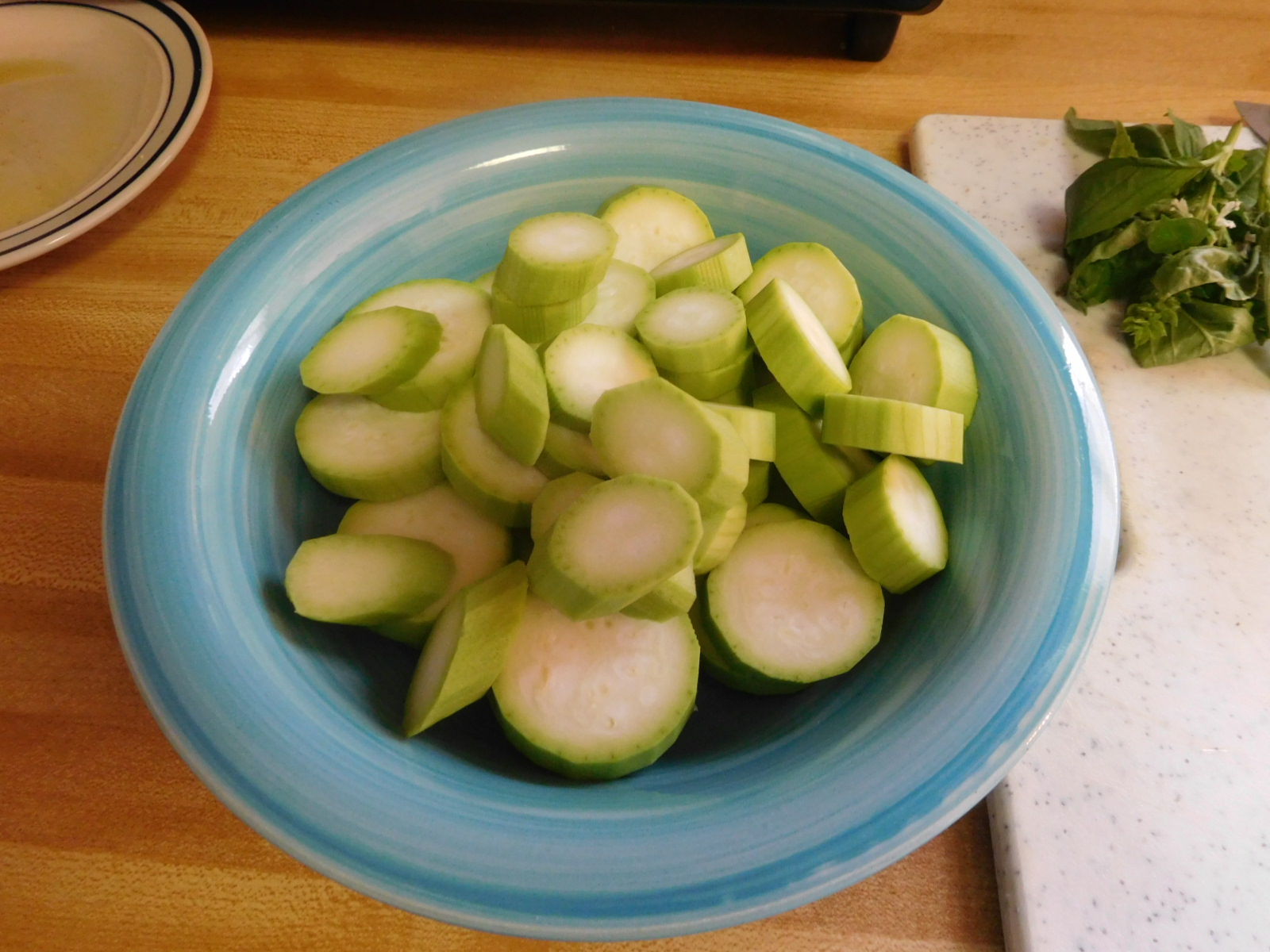
Peeled and cut into disks

Basil
Basil, garlic and olive oil sauce
Fried in olive oil


Fried Cucuzza Sticks as Stuzzichini (finger food)


Sauteed tenerumi (leaves and tops) with pasta


Sauteed Cucuzza with onion and ground fennel, coriander and cumin seeds


Stuffed Cucuzza

Cut the cucuzza in half lengthwise and scrape out all but about 1/2 inch on the sides and reserve. 

Stuffing made of the cucuzza flesh cut from the halves, onion, garlic,chopped sweet pepper, currents, fresh parsley, hot pepper flakes sauteed in olive oil. Then mixed with coarse breadcrumbs. Salt and pepper to taste.
When cool, pack into the halves in a casserole dish
Topping is coarse breadcrumbs, pecorino cheese and olive oil
Add a little water to the casserole dish, cover with foil and bake at 375 for 20 min. Uncover and bake for another 10 minutes at 400.


Soon - Cucuzza Fritters

Saturday, August 27, 2016

Eggplant Preserved in Olive Oil - Melanzane Sott'Olio

This time of year production in vegetable gardens is starting to wind down so if you haven't made plans for preserving some of your veggies, to enjoy later in the year, it's important to figure it out now. Pickled eggplant packed in olive oil with garlic and herbs is a great way to preserve garden grown (or store bought) eggplant. In southern Italy this is the primary way to preserve their beloved eggplant and is called melanzane sott'olio - literally, "eggplant under oil". Maybe you grew up with this, maybe you've had this as part of an antipasti assortment or sadly, maybe you've never heard of it... if you haven't, you can start now. You won't be sorry. 


Like a lot of "traditional" dishes, there are local variations and of course variations within families - different procedure preferences, different varieties of eggplant, different seasonings, different ways to slice, but common to all are a couple of easy, but important, steps you need to follow. The photos below lay this out. But here they are - 
  
1 - Sliced pieces or strips of eggplant are salted to draw out the moisture. This liquid needs to be squeezed out.
2 - Cook the eggplant pieces briefly in wine vinegar, and then squeeze out the excess vinegar.
3 - Add in the seasonings while layering the eggplant slices in a canning jar.  
4 - Let the flavors marry together for several weeks - or more. It gets better over time.
                              
I used these eggplants are from our garden - three Japanese eggplants and one black beauty.

Peel the eggplants and cut into strips. You could cut into thin slices crosswise or lengthwise but I prefer the strips.

Put the eggplant strips in a glass or ceramic bowl and add - for this amount of eggplant - about 1/3 cup Kosher salt. Mix through with your hands and let sit for 3 - 4 hours.The salt will pull much of the water out of the eggplant and make the pieces very pliable. In the bottom of the bowl there should be a pool of brown liquid. 

Drain the liquid and squeeze rest of the water out of the eggplant with your hands or put the eggplant in a colander with a weight on top or if you have a potato ricer, use it to squeeze out the rest of the liquid, like this - 


Pour white wine vinegar in a pot and bring to a boil. For the amount of eggplant I had, I used 2 1/2 cups.The amount of vinegar should be enough to cover the eggplant. Add the eggplant slices and cook for 3 minutes.Take off the heat and drain. Let cool. Then, using the same method as before, squeeze any excess vinegar out and put the eggplant slices in a bowl.


For the seasoning, I like to use minced garlic, sliced hot Calabrese pepper and fennel seeds. Some people like other herbs like basil or mint instead of fennel. Use what you personally like. Typically garlic and hot peppers are the two main seasonings.

Garlic - minced

Fennel seeds. These we grew, but use store bought fennel seeds

Hot Calabrese pepper. We grow these too, but you can use store bought chilies. Slice these into thin rings.

Put a little olive oil in the bottom of a caning jar and sprinkle a little garlic, sliced hot pepper and fennel seeds. Add enough eggplant to fill about 1/4 of the jar, Then repeat the seasonings and eggplant, 1/4 at a time until the jar is 3/4 full. Pressing firmly as you go to remove any air spaces. Finish by adding a  thin layer of olive oil., 
Put the lid and ring on the jar and refrigerate for about a week or two for the eggplant to absorb the flavors of the seasonings - if you can wait that long. Keep refrigerated but bring to room temperature to serve. Kept refrigerated, this will keep for six months. 

Clay figurine from Calabria, Italy, looking over one of the jars with discerning approval.


Wednesday, June 8, 2016

Eggplant with MInt

This eggplant dish is perfect as an antipasto, party food, a summer side dish or to take on a picnic. All the flavors work well together - garlic, mint, a bit of vinegar for tartness and of course the earthiness of the eggplant. Easy to make a looks cool on a serving plate. Here's how you do it - 

Ingredients:

1 large eggplant 
Oil for frying (all olive oil or 2/3 olive oil/ 1/3 canola oil)
2 cloves of garlic chopped
10 fresh mint leaves chopped

White wine vinegar

Thinly sliced hot chili to taste
3 - 4 tbsp extra virgin olive oil
4 tbsp coarse breadcrumbs
Kosher salt


Process: 
Peel a little of the skin off the eggplant and cut the eggplant lengthwise into pieces about 3“x 1”.
Put the pieces in a colander and sprinkle with Kosher salt

Let them sit in the colander for about half an hour.
Wash off the salt and dry the eggplant pieces on paper towels.
Fry the eggplant pieces in about ¼ inch of oil until browned. Don’t crowd the pan – fry in batches. 
Let drain on paper towels, then put on a serving plate
In a bowl, mix the extra virgin olive oil and the garlic together and drizzle over the eggplant pieces.
Sprinkle the mint, chili, white wine vinegar, a little salt and bread crumbs over the eggplant.
Serve at room temperature.


Friday, March 25, 2016

Seed Bombs - Creative Help for the Declining Honey Bee Population

Seed "Bombs"
It is very clear that there has been a major decline in the honeybee population. As an avid vegetable gardener I am very concerned.

Just a little background that many of you already have some familiarity with. Colony collapse disorder (CCD) is the mysterious abrupt disappearance of worker bees from the bee colony. During the past 20 years, beekeepers around the world have observed this mysterious and sudden disappearance of bees, and unusually high rates of decline in honeybee colonies. These kinds of disappearances are not new and have occurred throughout the history of beekeeping. In the past they were known by various names - disappearing disease, spring dwindle, May disease, autumn collapse. More recently the syndrome was renamed colony collapse disorder in light of this drastic rise in the number of disappearances of western honeybee colonies in North America and Europe.  

Colony collapse disorder is significant economically and effects all of us because so many agricultural crops are pollinated by honey bees. The whys and hows of CCD and the reasons for its increasing prevalence remain unclear and controversial. Many possible causes have been proposed: pesticides, primarily neonicotinoids; infections with varroa mites; malnutrition; various pathogens;  genetic factors; loss of habitat; changing beekeeping practices; or a combination of these.

One simple way we can help is to increase pollinator habitat by planting native wildflower seeds all over the place. Check out this video showing what the company that makes Seedles, has done. Seedles are wild flower seeds encased in clay balls made of seed bombs. that can be hand broadcast and This company -


Here are links to a few resources that show a simple way we can help that is much more than just a symbolic gesture with no substance - you are actually doing something constructive.

http://www.psmag.com/navigation/nature-and-technology/save-the-honeybee-sterilize-the-earth-pollination-industrial-complex-95566/

http://growtherainbow.com/

http://www.organicgardening.com/learn-and-grow/diy-seed-bombs

http://www.thinkgeek.com/product/edb1/

Thursday, March 24, 2016

Adventures in DNA Analysis - Discovering Our Ancient Origins

This will be a departure from the usual food and garden posts but it does fit in very well with "good stuff for the soul". Lisa and I thought it would be interesting to get our DNA tested to explore our genealogical make up. Maybe you’ve seen the ads on TV for Ancestry and 23 and Me. Ancestry is a well known genealogy web site that has more recently gotten into the DNA analysis business. 23 and Me is a company set up to do DNA analysis. Lisa went with Ancestry. Among other things, they will give you a report on what percentage of your DNA makeup comes from what part of the world by geographic region. I used 23andMe because they will also test for your Maternal and Paternal DNA haplogroup

With both Ancestry and 23andMe you receive a kit that includes a test tube-like container that you fill with spit. Your spit contains cells from lining of your mouth. DNA from those cells is extracted and analyzed. We sent them off in early February and got them back last week.

If you enjoy history, are interested in learning more about your family's ancestral roots and you feel your ancestors are living within you and want to know more about them (like we do), read on. You might want to have DNA testing done too. Here is a comparison chart of labs that do DNA testing for genealogical research - 

DNA Testing Providers Comparison Chart

Without getting too much in the weeds, this is my understanding of how this all works - 

Most of us have some degree of understanding of what DNA is. We know it is something in our cells that can be used to identify characteristics about ourselves such as parenthood (You ARE the baby's daddy!) or physical traits that can be passed down from your parents/grandparents like blood type, male pattern baldness (not me though :)), eye color, toe arrangements... and a propensity to have certain health issues, DNA evidence left behind at the scene of a crime can be used to help convict or exonerate a suspect. BUT there is so much more. The DNA that we carry in our cells is a compilation of all of our ancestors going back many many years. Some believe that our ancestors memories are also passed along to future generations through DNA. So if you are interested in genealogy and learning about your family's roots, DNA contains a treasure trove of information for you. Genetic scientists have learned how to unlock and access this amazing window into who our ancestors were and where they came from. For all intents and purposes you ARE your ancestors! They lived and loved and struggled for millennia just for you to exist today. Don't disappoint them. Live a good life! 

We have hundreds of thousands of ancestors. The number of ancestors doubles each generation we go back: 2 parents, 4 grandparents, 8 great-grandparents, 16 great-great grandparents, 32 great-great-great grandparents and on and on. There is type of DNA - autosomal DNA - that determines most of the DNA traits we inherit. Because it is a mixture of all those thousands of ancestors from both our fathers and mothers sides, we can’t tell which specific ancestors we inherited what traits from. However, it can still show us our ethnic makeup and the geographic region our ancestors lived in. For example, what percent of our DNA makeup is Italian or Irish or German, or Mediterranean or Scandinavian, North African, Polynesian, etc.

But it gets even more interesting. Of those thousands of grandparents we have, only two of them - our direct male line - father’s father’s father’s line going way back thousands of years in time and our direct mother’s mother’s mother’s line also going way back in time - have left specific mutation markers in their DNA that is carried forward to future generations. They are y-DNA and mt-DNA.

Y-DNA tells the origin of a person’s genetic paternal line(father to son), representing your own original “Adam”, so to speak. This piece of DNA has a mutation - a genetic marker - inherited from father to son in a direct line going back, virtually unchanged, over thousands of years. So the y-DNA that a male carries in his cells today, correlates with his distant paternal grandfather’s y-DNA thousands of years ago—and it stores a history of the migration pattern and deep ethnic roots of this particular grandfather.

Likewise, mt-DNA tells the origin of a person’s genetic maternal line (mother to daughter) representing one’s own original “Eve”. This piece of DNA has a mutation that is inherited from mother to daughter in a direct line going back, virtually unchanged, over thousands of years. The mtDNA that you carry in your cells today, correlates with your distant maternal grandmother’s mt-DNA thousands of years ago—and like y-DNA, stores a history of the migration pattern and deep ethnic roots of this particular grandmother.

So how do they do this?  To analyze and organize all this y and mt DNA data, genetic scientists have created a HUMAN MALE FAMILY TREE and a HUMAN FEMALE FAMILY TREE. The branches of this tree are called haplogroups. Through research and testing different populations all over the world geneticists can trace and track concentrations of haplogroups along with the genetic mutations that give them their particular characteristics. We all belong to a particular branch. Through y-DNA and mt-DNA analysis each branch can be traced back to its origin, where it is attached to the genetic “tree trunk”.

OK, finally, the RESULTS!

Turns out Lisa’s genetic makeup is 100% European, broken down like this –

38% Western European (Germany, France, Belgium, Netherlands)
22% Great Britain (England, Scotland, Wales)
15% Ireland
14% Scandinavia (Norway, Sweden, Denmark)
8% Iberian (Spain, Portugal)
3% Finland, NW Russia

She pretty much figured she was some combination of English and Western European but the Scandinavian and Iberian was a big surprise. We can't find anyone in her family tree going back several centuries that is Scandinavian, Spanish or Portuguese.

Now, as for me, we found out I am 99% European, broken down like this - 

23% Southern European (Italy, Greece, Mediterranean Islands)
22% Great Britain (England, Scotland Wales)
44.5% Western European (Germany, France, Belgium, Netherlands)
5.6% Scandinavian  (NorwaySwedenDenmark)
3.9% Eastern European (Poland, Russia, Czech Republic, Slovakia, Hungary)
1 % African

My results make sense except for the 1% African, but I'll take it. Now, if your brother, sister had their DNA analyzed, they may be quite a bit different than your results because even though you are very closely related you inherit different parts and amounts of your ancestors genes. 

And oh, 23 and Me also tests for the amount of Neanderthal DNA you have... I have some.

Haplogroup results

The analysis I got from 23 and Me determined that the haplogroup of my paternal branch of the Human Male Family Tree is J2b2*. This haplogroup originated some 10,000 plus years ago in what was Mesopotamia. Over the centuries my grgrgrgr+ grandfathers migrated from Mesopotamia through Syria, across Turkey, Greece, the Balkans and over into southern Italy where they stopped for about 1000 or so years until my great grandfather Bruno Fusca’ decided to leave the little town of Vazzano, Italy in 1895 and bring the family to America settling in Pittsburgh, Pennsylvania adding another migration arrow.


Migration routes for haplogroup J2b2* over the last 10,000 years
Haplogroup J2 as a % of the population - current
The haplogroup of my maternal branch of the Human Female Family Tree is H11a. This haplogroup originated about 10,000 years ago in what is now western Russia. Over the centuries my grgrgrgr+ grandmothers migrated from the Steppes of Russia through eastern Europe, across Germany and France and up into England. Maybe some were carried off by invading armies or fled from invading armies. In 1839 my grgrgr grandmother, 13 year old Mattie Sinclair, left out of LiverpoolEngland with her widowed father and family to settle in KittanningPennsylvania
Migration route for haplogroup H11a over the last 10,000 years
And so, as fate would have it, from my own original "Adam and Eve" some 10,000 plus years ago, through all those thousands of grgrgr+ grandfathers and grandmothers and all those countless miles of migration spanning the Mideast and Europe eventually crossing the Atlantic, Bruno Fusca's grandson Tom met and fell in love with Mattie Sinclair's great granddaughter Elizabeth next door neighbor childhood sweethearts and made me and my sister. It was all meant to be.

Sunday, January 31, 2016

Loose Meat Sandwiches

Our version with added bread and butter pickles, a side of homemade french fries and a cold beer.

I have to confess my ignorance here. I never heard of  Loose Meat Sandwiches until this election year during the current coverage of the political campaigning in Iowa prior to the Iowa Caucuses. Apparently Loose Meat Sandwiches are a Hawkeye State specialty. I heard them being talked about during a lighter side news coverage segment of the campaign this morning. Lisa and I decided to find out what the heck they were, how they differed from "tight meat" sandwiches and how we could make them in our very own test kitchen here in Georgia. 

We found out quickly that the founder of an Iowa based restaurant chain - Maid-Rite originated these sandwiches back in the 1920's and that they couldn't be easier to make. Not surprisingly, as their name implies, they are loose meat sandwiches, basically Sloppy Joes without the slop. Their flavor comes from a few key ingredients: a good grade of ground beef, onions, garlic powder (we used minced garlic), yellow mustard, and Worcestershire sauce. We also used a little white vinegar.

Ingredients

1 lb ground chuck
1 medium onion, minced (reserve some for garnish)
1 Tbsp yellow mustard
1 Tbsp white vinegar
1 Tbsp Worcestershire sauce
2 tsps. sugar
1 clove garlic minced
salt and pepper to taste
6 hamburger buns
Sliced pickles
Instructions

Heat a large saute pan or skillet on medium heat.
Add onion and cook until translucent
Add ground beef and cook until browned
Mix in the other ingredients until well combined
Serve on toasted hamburger buns topped with minced onions and pickles and a side of fries. Have a fork handy because the loose meat is going to tumble out of the bun with every bite.

Wednesday, January 27, 2016

Bacon Chocolate Shot Glasses Whoah!

Have to share this with you from another food blog - http://throughtheeyesofmybelly.com/

Thank you Through the Eyes of My Belly!  Very clever!


I will update with photos of us making them here.


How to make bacon and chocolate shot glasses

Saturday, January 16, 2016

Roasted Cauliflower With Indian Spices


This will totally change your perception of cauliflower. Addictive!

Ingredients

1 head Cauliflower
3 cloves Garlic, minced
1 Tsp Chili Powder
1/2 tsp crushed hot pepper flakes
1 tsp powdered Cumin
1 tsp Garam Masala
1 tsp Turmeric
4 Tbsp Olive Oil
1/4 cup Cilantro leaves, chopped
1/2 Lime, juiced
Salt to taste

Instructions

Preheat oven to 400 F. 

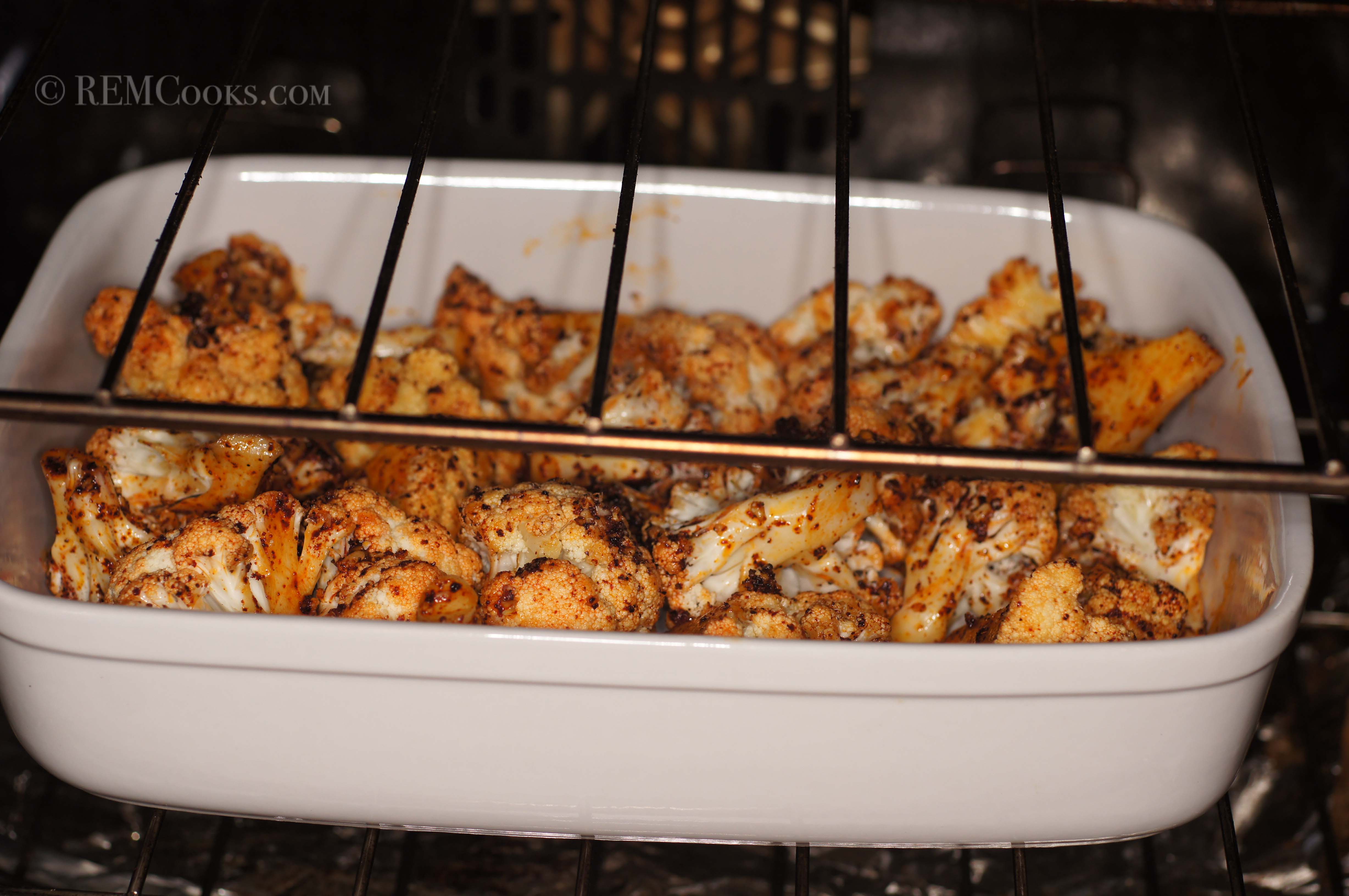
Separate the Cauliflower into small to medium florets and spread them out in a shallow roasting pan

In a bowl, mix together the garlic, chili powder, red pepper flakes, cumin, turmeric, garam masala, salt and olive oil

Pour the spice and olive oil mixture over the florets and toss gently to mix together and coat well.

Roast for 40 minutes or until tender, stirring occasionally.

When done, remove from oven, d
ress with lime juice and the chopped cilantro leaves.


Tuesday, December 8, 2015

Awesome Home Fries and Eggs

What can make humble home fries and eggs awesome... and fill you home with a wonderful aroma at the same time?  Check this out - 

Ingredients:
4 tablespoons (1/2 stick) unsalted butter
4 medium russet potatoes, peeled, cut into 1 inch chunks and parboiled in salted water until just done but still firm
1/2 sweet onion cut into strips
1 teaspoon sumac * (or sub with garam masala)
1/2 teaspoon paprika
1/4 teaspoon turmeric
1 teaspoon lime juice
Kosher salt
1/2 teaspoon freshly ground black pepper
1 tablespoon vegetable oil
1 Fresno chile, chopped or thinly sliced
1/4 cup coarsely chopped mixed herbs - an equal combination of cilantro and parsley
4 large eggs

Sumac is a widely used, essential spice in Middle Eastern and Mediterranean cooking. It has a tangy lemony flavor, although more balanced and less tart than lemon juice. It's used in everything from dry rubs, marinades, and dressing. But its best use is sprinkled over food before serving. It's great over vegetables, grilled lamb, chicken and fish. Not readily available in supermarkets, but it is available easily on line and worth having some in your spice cabinet. When mixed with thyme and sesame seeds, it is called za'atar.

For the Home Fries
Heat the butter in a large cast-iron skillet over medium-high heat until it begins to shimmer. Add onion and cook until soft, about 5 minutes.
Add the potatoes, garam masala, paprika, turmeric and a very generous amount of salt and toss to coat the potatoes and onions. 
Use a spatula to press and crush the potatoes against the bottom of the pan. Cook until golden brown and crisp on the bottom, about 5 - 7 minutes. 
Turn over in large chunks and press again to crisp the other side. 
Cook until browned on the bottom, another 5 - 7 minutes.
Taste and add salt as needed.

While the potatoes crisp, heat the vegetable oil in a non-stick skillet over medium heat. Add the chiles and cook, stirring, until warmed and very slightly softened, about 1 minute. Add the herbs.

Spoon the chile herb mixture over the potatoes and drizzle with the lime juice. 

Serve straight from the pan. Leave a little of the oil and herbs in the pan.

For the eggs

Cook the eggs as you like in the pan you made the herb chili sauce.